
Home / Health (page 30)

Health

Health

Adar Poonawalla: Everything falls on my shoulders but can’t do it alone: Adar Poonawalla on vaccine pressure in India

Serum Institute of India CEO Adar Poonawalla on Saturday spoke out about the pressures he was under over the production of COVID-19 vaccines to meet the ever-increasing demand in India as the country battles through a devastating second wave of the coronavirus pandemic.

In his first comments since he was provided with ‘Y’ category security by the Indian government earlier this week, Poonawalla told ‘The Times’ in an interview about receiving aggressive calls from some of the most powerful people in India, demanding supplies of Covishield — the Oxford/AstraZeneca COVID-19 vaccine that the Serum Institute is producing in India.

That pressure is largely behind his decision to fly into London to be with his wife and children, the 40-year-old entrepreneur said.

“I’m staying here (London) for an extended time because I don’t want to go back to that situation. Everything falls on my shoulders but I can’t do it alone…I don’t want to be in a situation where you are just trying to do your job, and just because you can’t supply the needs of X, Y or Z you really don’t want to guess what they are going to do,” Poonawalla told the newspaper.

According to Indian government officials, the protection to Poonawalla has been given in view of “potential threats” to him. Armed commandos of the Central Reserve Police Force (CRPF) will be with him every time he travels to any part of the country, they said and added that the ‘Y’ security cover will entail a posse of about 4-5 armed commandos.

“The level of expectation and aggression is really unprecedented. It’s overwhelming. Everyone feels they should get the vaccine. They can’t understand why anyone else should get it before them,” Poonawalla said.

The businessman indicated in the interview that his move to London is also linked to business plans to expand vaccine manufacturing to countries outside India, which may include the likes of the UK.

“There’s going to be an announcement in the next few days,” he said, when asked about Britain as one of the production bases outside India.

According to the newspaper, by the time the Oxford/AstraZeneca vaccine was approved in January this year, the Serum Institute of India (SII) had increased its annual production capacity from 1.5 to 2.5 billion doses at a cost of USD 800 million, and stockpiled 50 million doses of Covishield.

The company began exporting to 68 countries, including Britain, as India seemed to have been over the worse, until the situation worsened in recent weeks.

“We’re really gasping for all the help we can get,” Poonawalla said in the ‘Times’ interview.

“I don’t think even God could have forecast it was going to get this bad,” he said.

India is struggling with a second wave of the pandemic with more than 3,00,000 daily new coronavirus cases being reported in the past few days, and hospitals are reeling under a shortage of medical oxygen and beds.

India’s daily coronavirus tally crossed the grim milestone of four lakh on Saturday, while the death toll rose to 2,11,853 with 3,523 fresh fatalities.

On the charge of profiteering as the cost of Covishield was recently hiked, he termed it as “totally incorrect” and added that Covishield will still be “the most affordable vaccine on the planet” even at a higher price.

“We have done the best we can without cutting corners or doing anything wrong or profiteering. I’ll wait for history to judge,” he said.

“I’ve always had this sense of responsibility to India and the world because of the vaccines we were making, but never have we made a vaccine so needed in terms of saving lives,” he added.

The Serum Institute on April 21 had announced a price of Rs 600 per dose for private hospitals and at Rs 400 for state governments and for any new contract by the central government.

The announcement followed widespread criticism of the company’s pricing policy as it has sold the initial doses of Covishield to the central government at Rs 150 per dose. Many states objected to the different prices for the vaccines.

Subsequently, SII on Wednesday announced a cut in price of the jab it plans to sell to states to Rs 300 per dose.
News Source link

Cyberabad police launches ‘Portal for verified info on Covid’, Health News, ET HealthWorld

Hyderabad:  Cyberabad police launches 'Portal for verified info on Covid'Hyderabad: The Cyberabad police on Friday launched the website COVID.SCSC.IN for verified information on Covid-19 related services available in the city.
Officials said that the effort will enable citizens to access verified information that will help them while dealing with patients under critical care, self care and preventive care.

Critical care services will give information about ambulance services, oxygen suppliers, hospitals and beds, plasma support, blood banks, cremation services and self-care services.

Similarly, isolation centers and home quarantine support services will have information about doctors on call, diagnostic centers, pharmacies, food services and preventive care services.

The website will also give information about vaccination centres, PPE suppliers and sanitisation services. Recently, a free Covid telemedicine call center was launched, wherein doctors from various hospitals give free consultation for persons in need of medical advice.

Few days ago, Cyberabad and Rachakonda police had started ambulance and free cab services.

News Source link

A Day After Conclusion Of Election, West Bengal Govt Imposes New Covid-19 Restrictions; Know What’s Allowed What’s Not

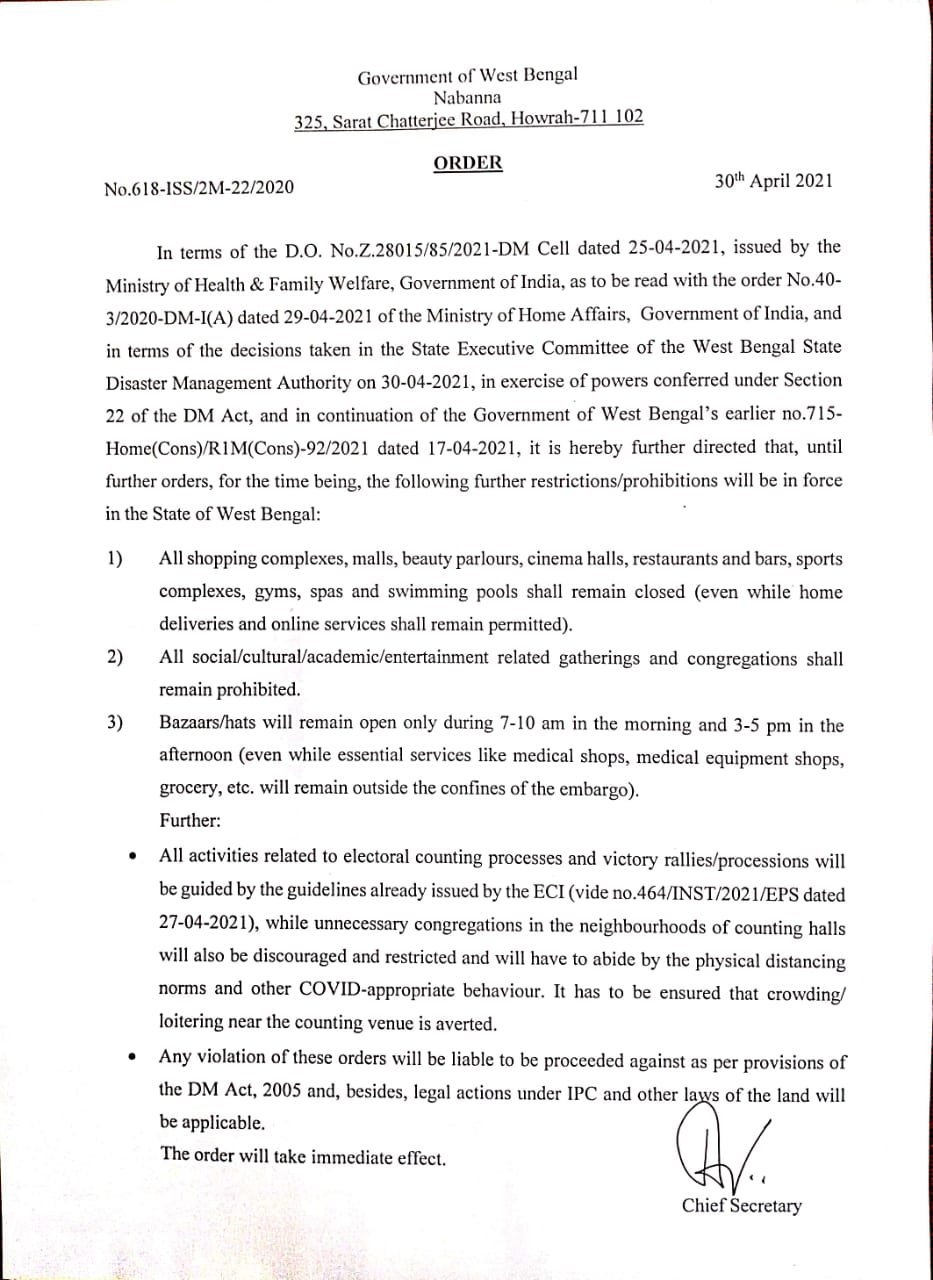
Kolkata: West Bengal government on Friday announced fresh Covid-19 restrictions. As per the new order, shopping complexes, malls, beauty parlours, cinema halls, restaurants, bars, gyms and sports complexes will remain closed until further orders.

The decision comes just a day after the conclusion of 8-phase assembly election in the state. 

ALSO READ | ‘All Arms Of Govt Working Unitedly & Rapidly’: PM Modi Tells Union Council Of Ministers In Meeting Over Covid Crisis

West Bengal government has now imposed the following restrictions in the state:

  • Shopping complexes, malls, beauty parlours, cinema halls, restaurants, bars, gyms and sports complexes will remain closed.
  • Online services and home delivery permitted.
  • All social/cultural/academic entertainment-related gatherings and congregations prohibited.
  • Bazaars/Haats will remain open only from 7 to 10 am in the morning and 3 to 5 pm in the afternoon.
  • Essential services to remain outside the said time restrictions.

As for the restrictions related to election result announcement day (May 2), the order states that “All activities related to electoral counting processes and victory rallies/processions will be guided by the guidelines already issued by the ECI”.

“Unnecessary congregations in the neighbourhoods of counting halls will also be discouraged and restricted and will have to abide by the physical distancing norms and other Covid appropriate behaviour,” it adds stating that “it has to be ensured that crowding/loitering near the counting venue is averted”.

Here is a copy of the order:

A Day After Conclusion Of Election, West Bengal Govt Imposes New Covid Restrictions | Know What's Allowed, What's Not

(Source: ANI)

Election & Covid Surge

Over 76 per cent voter turnout was recorded till 5:30 pm during polling for the eighth and final phase of the West Bengal Assembly elections on Thursday.

The overall polling process was reported to be peaceful barring a few stray incidents of violence. Earlier in the day, firecrackers were set off outside central Kolkata’s Mahajati Sadan, which were initially alleged to be crude bombs but the preliminary investigation revealed that banned firecrackers were set off and not bombs.

The extensive 8-phase polling preceded by mass campaigning by political parties is being seen as the reason behind the surge of Coronavirus cases in the state.

With two phases remaining, Election Commission had banned all physical and vehicle rallies taking note of Coronavirus norms violation. 

In the latest figures, West Bengal recorded 17,403 new Covid-19 cases on Thursday taking the total tally to 8,10,955. The overall death toll was reported to be 11,248 with 89 new fatalities. Total active cases in the state are 1,10,241.

Meanwhile, the Election results are going to be announced on Sunday after the counting of votes. EC has been directed to ensure proper Covid norms and parties have been asked to not indulge in major victory celebrations/processions in view of the current situation.

News Source link

Covid-19 Restrictions Extended In Maharashtra Till May 15

Mumbai: Amid the unprecedented increase in Covid-19 cases in Maharashtra, Chief Minister Uddhav Thackeray-led government on Thursday extended the current restrictions throughout the state beyond 7 a.m. on May 1 till 7 a.m. on May 15 in a bid to break the chain of transmission effectively.

“It is imperative to continue emergency measures to prevent and contain the spread of the virus,” said the order signed by Maharashtra Chief Secretary Sitaram Kunte and issued in the name of Governor Bhagat Singh Koshiyari.

READ: UP Extends Weekend Lockdown: New Restrictions Announced, Timings Extended Till Tuesday Morning 7 AM

“Now, therefore, in exercise of the powers conferred under Section 2 of the Epidemic Diseases Act, 1897 and the powers, conferred under The Disaster Management Act, 2005, the undersigned, in his capacity as Chairperson, State Executive Committee, hereby extends all the restrictions that have been imposed vide ‘Break the Chain’ orders dated 13th April and 21st April 2021 along with all additions and clarifications issued thereof in the State till 7 AM on 15th May 15, 2021,” the order said.

This comes as fatalities continue to rise alarmingly in Maharashtra, which is the worst affected by the Covid-19 pandemic. Maharashtra witnessed the maximum casualties 1,035 in the last 24 hours followed by Delhi with 368 daily deaths.

READ: Uttarakhand Suspends Char Dham Yatra For 2021 Amid Spiralling Covid Cases

The state has recorded over 63,000 new cases, taking the tally to over 44 lakh.

News Source link

THIS Twitter feature informs everything about Covid-19 vaccine on user timelines | Technology News

Microblogging platform Twitter has now come out to contribute in making people aware of the COVID-19 vaccine and push people towards the vaccination.

The Twitter prompt appears on top of the timeline in a box.  “As COVID-19 vaccinations become more widely available, we want you to have access to the latest vaccine info in your country. This week you’ll see a prompt in your timeline that links to sources about vaccine safety, efficacy, and news from public health experts,” Twitter said in a tweet.

This prompt will appear on Twitter on its Android and iOS apps and the shape of the box is quite big as it can take half of the phone’s screen. The name of the box is “Covid-19 Vaccines: Know the facts”. 

To know about the COVID-19 vaccines, one needs to tap on the link in the card and then you will be redirected to a Twitter events page which will further inform you about the company’s collated information on the vaccine from reliable sources.  

The page informs about several queries regarding the COVID-19 vaccine which includes vaccine effectiveness, potential side effects, different vaccines and variants, advice for pregnant people, getting multiple vaccines at once, and more.

After that, one can see various tweets from resources like the World Health Organisation informing about the different COVID-19 vaccines.

This Twitter feature comes in the aftermath of India’s next vaccination drive which initiates from May 1 for people aged between 18 and 45.


Live TV

#mute

News Source link

A fatty liver can be dangerous to your heart | Health News

New Delhi: ‘Fatty Liver’ commonly finds mention in an ultrasound examination report and is often passed off as an incidental finding, it may not be innocuous after all, suggest recent studies in reputed medical journals.

Japanese and European scientists were the first to report a strange four-fold increase in heart disease in these patients compared to those of the same age and sex who had normal livers. And their observations are proving true across the world.

Using sophisticated techniques, doctors have found the wall of arteries to be thicker and the lumen narrower, causing reduced flow of blood to their heart muscles and brains, in these patients. Their findings support the clinical observation that those with excess fat in their livers are more vulnerable and die earlier from heart problems.

The appearance of a ‘bright’ and swollen liver suggesting excess fat deposition is a common finding on ultrasound examination. While it is commonly seen in drinkers, it is often seen in tee-totallers too, and is referred to as non-alcoholic fatty liver disease or NAFLD in them. Although the risk of liver damage due to this fat is modest and occurs in only 20 per cent when present for over 20 years, proneness to heart attacks grossly increases.

If a fatty liver is detected or suspected, a reliable simple way to find out “how much fat” and “how bad the liver’s condition is” can be answered by a test called Liver Fibroscan (with CAP), a simple, painless, non-invasive test that takes only 10 minutes and gives you the important answer.

NAFLD is usually associated with obesity, diabetes, hypertension or high amounts of circulating fats in the blood, and is often called a “Lifestyle Disorder”. Lack of adequate exercise and consumption of excess calories have been shown to lead to obesity and excess fat deposits in the liver.

The mechanism underlying this disorder called Insulin Resistance, is like that which occurs in diabetics of the Type 2 variety or the common adult type, in which patients have high circulating levels of Insulin that prove ineffective in driving sugar into cells. Insulin Resistance also causes excess accumulation of fat in liver cells, as well as thickening of arteries that cause heart or brain disease.

Regular exercise and reduction of weight form the fulcrum of treatment for this disorder. Apart from helping reduce weight, aerobic excercise up-regulates a protein (glut-4) that restores the sensitivity of cells to circulating insulin. Hence insulin and sugar levels both come down, fat gets mobilised from the liver, buttocks and abdomen, and the increased risk of heart disease is restored to normal levels.

India is in the eye of an emerging global epidemic of diabetes and heart disease. While our genes may be partly accountable for our misfortune, the greater share of blame lies in our reluctance to exercise regularly. While vagaries of weather and unsafe roads may come as handy excuses, we Indians, more than any other race, need to shake off our laziness and indulge ourselves in far more and regular exercise than what we are doing at present. And we need to start quite urgently if we need to live longer and healthier lives.

Effective medications are now available to help you shed fat from your liver. But much depends on your motivation and will power to adhere to a “diet-and fitness” regime to get your liver and heart into good shape.

News Source link

Teaching the art of living with Diabetes- The New Indian Express

Express News Service

UTTARAKHAND:  Rekha Negi (29) recalls with dread her six months of nightmare four years back in dealing with her undiagnosed Type 1 Diabetes which left her debilitated to the core. But then, she mustered her will power to tell herself that she must save others like her. Type-1 Diabetes is an autoimmune condition in which the pancreas produces little or no insulin, making the body incapable of balancing the blood sugar levels.

When her suffering eased a bit, she started Uttarakhand Diabetes Awareness Initiative (UDAI). She has so far helped over 100 families,  including children as small as two years old,  diagnosed with the condition.
The reach of her comforting hands has extended to many countries — Pakistan, Australia and the US. “I had lost almost everything. I went through HIV, cancer and every other test while I was bedridden due to complications to find out what was wrong with me,” she says. 

“My biggest fear was that I would be found dead all alone, away from my loved ones. I did not want anyone to go through the suffering, so I thought of helping others overcome, understand and live with Type 1 diabetes,” says Rekha, an MBA in marketing and human resources with a B. Tech degree. During the Covid period, she has helped young children deal with the condition and their families to accept and understand the situation to deal with it better.

“Imagine a six-year-old child in a remote village of Rudraprayag district with little facilities. Apart from a physical condition, the disease takes a toll on one’s mind. I try to counsel the families and make them aware that perfectly normal life is possible with this condition.” She says many celebrities such as Sonam Kapoor, Kamal Hassan and Nick Jonas are dealing with the condition successfully. “I want to reach out to more and more people through UDAI and assure them that they are no less than others,” she says. She and her team assist such people. The team includes volunteers, doctors, social workers and people from all walks of life.

The group, which also has government officials, helps children acclimatize with the surprises life has brought to them. Ashish Sethi, a doctor from Dehrdaun who works with Negi, says the group has come across children as young as six years old with sugar levels of 400, which is extremely dangerous to their life. “In UDAI we provide medical, financial and other assistance to save lives as well as improve the quality of life, making the child and the family believe that normal life is possible,” says Sethi. 

The group supplies Ketone test strips, medicines and other essential items in remote areas with scarce facilities. “The most daunting task is not making medical or financial arrangements. The challenge lies in making parents understand that their child can lead a normal life. Every day at least a couple of children are added in the group from Uttarakhand, Himachal Pradesh and other states,” says Negi, who worked in the corporate sector for two years in Mumbai and Delhi. The group also runs online and offline awareness campaigns about the medical condition, educating people to not associate themselves with any fear or taboo.

Helping children deal with the conditions
Rekha and her team that includes government officials, volunteers, doctors, social workers and people from all walks of life, assist people with Type 1 Diabetes. They help children acclimatise with the surprises life has brought to them. Ashish Sethi, a doctor from Dehrdaun, says the group has come across kids as young as six years old with sugar levels of 400 which is extremely dangerous to their life.

News Source link

FDA and CDC Lift Recommended Pause on Johnson & Johnson (Janssen) COVID-19 Vaccine Use Following Thorough Safety Review

Following a thorough safety review, including two meetings of the CDC’s Advisory Committee on Immunization Practices, the U.S. Food and Drug Administration and the U.S. Centers for Disease Control and Prevention have determined that the recommended pause regarding the use of the Janssen (Johnson & Johnson) COVID-19 Vaccine in the U.S. should be lifted and use of the vaccine should resume.

The pause was recommended after reports of six cases of a rare and severe type of blood clot in individuals following administration of the Janssen COVID-19 Vaccine. During the pause, medical and scientific teams at the FDA and CDC examined available data to assess the risk of thrombosis involving the cerebral venous sinuses, or CVST (large blood vessels in the brain), and other sites in the body (including but not limited to the large blood vessels of the abdomen and the veins of the legs) along with thrombocytopenia, or low blood platelet counts. The teams at FDA and CDC also conducted extensive outreach to providers and clinicians to ensure they were made aware of the potential for these adverse events and could properly manage and recognize these events due to the unique treatment required for these blood clots and low platelets, also known as thrombosis-thrombocytopenia syndrome (TTS).

The two agencies have determined the following:

  • Use of the Janssen COVID-19 Vaccine should be resumed in the United States.
  • The FDA and CDC have confidence that this vaccine is safe and effective in preventing COVID-19.
  • The FDA has determined that the available data show that the vaccine’s known and potential benefits outweigh its known and potential risks in individuals 18 years of age and older.
  • At this time, the available data suggest that the chance of TTS occurring is very low, but the FDA and CDC will remain vigilant in continuing to investigate this risk.
  • Health care providers administering the vaccine and vaccine recipients or caregivers should review the  Janssen COVID-19 Vaccine Fact Sheet for Healthcare Providers Administering Vaccine (Vaccination Providers)external icon

CDC’s independent Advisory Committee on Immunization Practices met today to discuss the latest data on TTS, hearing from the vaccine manufacturer Janssen and the COVID-19 Vaccine Safety Technical (VaST) Subgroup, as well as a risk benefit analysis. ACIP is committed to be vigilant and responsive to additional information that could impact the risk benefit analysis of any of these vaccines. Vaccine safety monitoring will continue and any new information about TTS will be brought to ACIP as needed.

“Safety is our top priority. This pause was an example of our extensive safety monitoring working as they were designed to work—identifying even these small number of cases. We’ve lifted the pause based on the FDA and CDC’s review of all available data and in consultation with medical experts and based on recommendations from the CDC’s Advisory Committee on Immunization Practices. We have concluded that the known and potential benefits of the Janssen COVID-19 Vaccine outweigh its known and potential risks in individuals 18 years of age and older. We are confident that this vaccine continues to meet our standards for safety, effectiveness and quality. We recommend people with questions about which vaccine is right for them have those discussions with their health care provider,” said Janet Woodcock, M.D., Acting FDA Commissioner.

“Above all else, health and safety are at the forefront of our decisions,” said CDC Director Dr. Rochelle P. Walensky. “Our vaccine safety systems are working. We identified exceptionally rare events – out of millions of doses of the Janssen COVID-19 administered – and we paused to examine them more carefully. As we always do, we will continue to watch all signals closely as more Americans are vaccinated. I continue to be encouraged by the growing body of real-world evidence that the authorized COVID-19 vaccines are safe and effective, and they protect people from disease, hospitalization, and death. I urge anyone with questions about the COVID-19 vaccines to speak with their healthcare provider or local public health department.”

Assessment of Available Data

Medical and scientific teams at the FDA and CDC reviewed several sources of information and data related to the Janssen COVID-19 Vaccine to reach today’s decision.

Specifically, the agencies assessed reports submitted to the Vaccine Adverse Event Reporting System (VAERS),external icon

Update on Adverse Events

On April 13, the FDA and CDC announcedexternal icon

Today, the agencies can confirm that a total of 15 cases of TTS have been reported to VAERS, including the original six reported cases. All of these cases occurred in women between the ages of 18 and 59, with a median age of 37 years. Reports indicated symptom onset between 6 and 15 days after vaccination.

Monitoring for Safety Will Continue

The surveillance systems that are in place to monitor the safety of COVID-19 vaccines authorized for emergency use are working, as demonstrated by both agencies’ quick work to identify and investigate these rare, but serious adverse events. The FDA and CDC will continue with these efforts to closely monitor the safety of these vaccines.

Reports of adverse events following vaccination can be made to the Vaccine Adverse Event Reporting Systemexternal icon

Additional Resources:

News Source link

IIT scientists , Health News, ET HealthWorld

India's Covid graph may peak at 33-35 lakh active cases by May 15: IIT scientists  The ongoing second wave of the Covid-19 pandemic in India may peak between May 11-15 with 33-35 lakh total ‘active’ cases and decline steeply by the end of May, according to a mathematical module devised by IIT scientists. On Friday, India saw a single-day rise of 3,32,730 (3.32 lakh) Covid-19 infections and 2,263 fatalities with 24,28,616 (24.28 lakh) active cases.
In predicting that the active cases would go up by about 10 lakh by mid-May before sliding, scientists from the Indian Institute of Technology in Kanpur and Hyderabad applied the ‘Susceptible, Undetected, Tested (positive), and Removed Approach’ (SUTRA) model.

The scientists also said Delhi, Haryana, Rajasthan and Telangana may see a high of new cases by April 25-30, while Maharashtra and Chhattisgarh might already have reached their peak in new cases.

“We have found that there is a reasonable chance that the active cases in India could peak sometime between May 11-15 with 33-35 lakh cases. It is a sharp slope, but on the way down, it would likely be equally sharp, coming down very fast and by end of May may see a dramatic reduction,” Manindra Agrawal, professor at the Department of Computer Science and Engineering, IIT-Kanpur, told .

The scientists in the as yet unpublished study said there are several novel features in the SUTRA model. Whereas previous papers divided the patient population into asymptomatic and Infected, the new model also accounts for the fact that some fraction of asymptomatic patients could also be detected due to contact tracing and other such protocols.

Earlier this month, the mathematical modelling approach predicted that active infections in the country would peak by April 15 but this didn’t come true.

“The parameters in our model for the current phase are continuously drifting. So it is hard to get their value right,” said Agrawal.

“Even a little bit of change each day causes the peak numbers to change by several thousand,” he explained.

The IIT Kanpur professor added that the SUTRA model’s prediction of the new peak is sensitive to the daily new infections data.

Agrawal noted that the model uses three main parameters to predict the course of the pandemic.

“The first is called beta, or contact rate, which measures how many people an infected person infects per day. It is related to the R0 value, which is the number of people an infected person spreads the virus to over the course of their infection,” Agrawal explained.

The other two parameters are ‘reach’, which is a measure of the exposure level of the population to the pandemic, and ‘epsilon’ which is the ratio of detected and undetected cases.

There are other mathematical modules as well.

Independent calculations by Gautam Menon and his team at Ashoka University in Haryana have predicted that the peak of the ongoing wave of infections could be between mid-April and mid-May.

Menon also cautioned that such projections of Covid-19 cases should really be trusted only in the short term.

“Any excessively precise prediction, of a peak within just a five-day window would ignore the many uncertainties associated with the inputs to any such calculation,” Menon, who was not involved in the modelling, had told earlier.

News Source link

Zydus gets emergency nod for Pegylated Interferon alpha-2b, ‘Virafin’ for Covid-19 treatment in adults, Health News, ET HealthWorld

Zydus gets emergency nod for Pegylated Interferon alpha-2b, ‘Virafin’ for Covid-19 treatment in adultsPharma company Zydus Cadila today received restricted Emergency use approval from India’s drug regulator for the use of Virafin, Pegylated Interferon alpha-2b (PegIFN) in treating moderate Covid-19 infection in adults.

When administered early on during Covid, Virafin will help patients recover faster and avoid much of the complications, the company said in a statement.

Virafin will be available on the prescription of medical specialist for use in hospitals.

“A single dose subcutaneous regimen of the antiviral Virafin will make the treatment more convenient for the patients,” the company said.

A multicentric trial was conducted in 20-25 centers across India, Virafin had shown lesser need for supplemental oxygen, indicating that it was able to control respiratory distress and failure which has been one of the major challenges in treating Covid-19. “The drug has also shown efficacy against other viral infections,” the company further said.

“The fact that we are able to offer a therapy which significantly reduces viral load when given early on can help in better disease management. It comes at a much-needed time for patients and we will continue to provide them access to critical therapies in this battle against Covid-19.” Sharvil Patel, Managing Director, Cadila Healthcare Limited said.

In its Phase III clinical trials, the therapy had shown better clinical improvement in the patients suffering from Covid-19. “The drug ensures faster viral clearance and has several add-on advantages compared to other anti-viral agents”.

News Source link